Best Smart Glasses of 2026: Ray-Ban Meta vs Meta Display, Rokid, Xreal, Even Realities
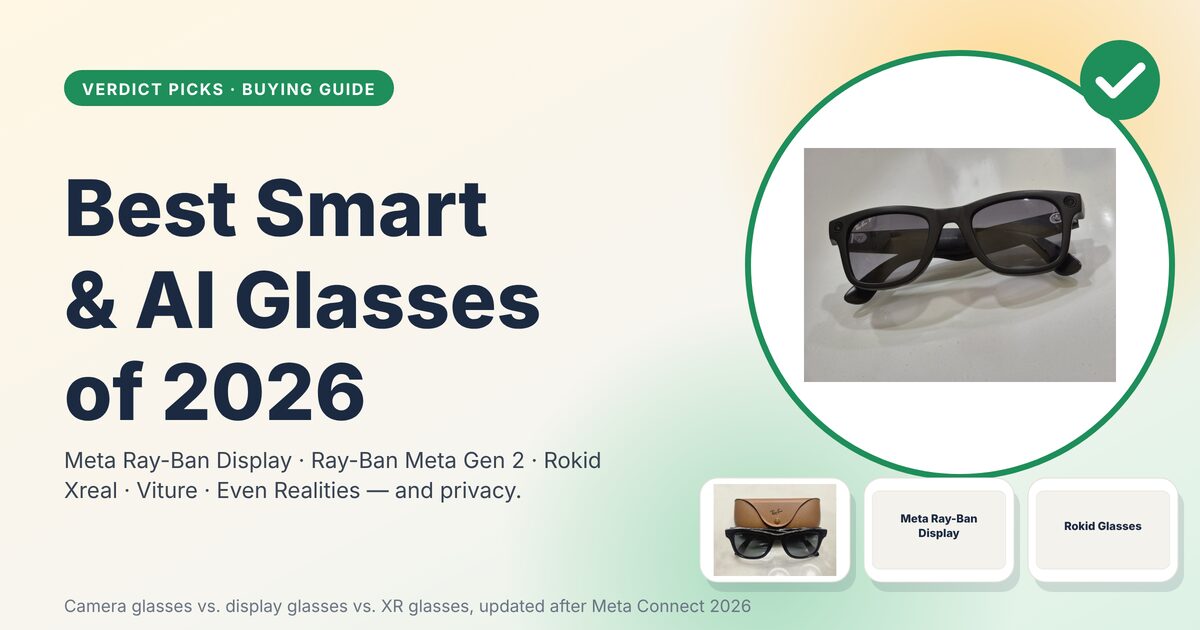
Short on time? For glasses that take photos and answer questions, buy the Ray-Ban Meta Gen 2 ($379) — Meta's new Gen 3, announced at Meta Connect on September 23, costs $449 for an extra hour of battery and better mics. For a screen in your lens, the Rokid Glasses ($599). For movies on a plane, the Xreal One Pro.
Guides: Robot Vacuums · Wireless Earbuds · Smart Glasses · Power Stations · Best Sellers · Price Check · Recall Check · Follow
Published September 12, 2026 · Updated October 20, 2026 · By Prof. H, professor of AI and robotics (Prof H Lab) (Vera, our host, is an illustrated persona) · As an Amazon Associate I earn from qualifying purchases. How we make money · How we rank
This spring a Korean YouTuber, Techmong, put on a pair of Rokid AI glasses and scored 96 on a mock college-entrance math exam — the answers appeared in his lenses. The video made the national news and got AI glasses banned from exam halls. It's also the best two-minute explanation of what these things do. "Smart glasses" now means three very different products, and buying the wrong kind is the number-one reason for returns. Below: which kind is yours, then which pair.
Key takeaways
- Camera + AI glasses: the Ray-Ban Meta Gen 2 ($379); the Gen 3 Meta launched on September 23, 2026 costs $449 for modest upgrades.
- A display in your lenses: the Meta Ray-Ban Display ($799; now also sold in Canada and the UK); the Rokid Glasses ($599) are the value alternative.
- No camera: the Even Realities G2 ($599) is the privacy-safe pick; XR video glasses like the Xreal One Pro are a different product.
- Before you wear them outside: run the day-one privacy checklist in this guide; camera glasses are already banned in exam halls.
한국어 요약 (Korean summary)
2026년 스마트·AI 글라스 10종을 비교했습니다. 카메라·AI 안경은 Ray-Ban Meta Gen 2($379, 9월 23일 발표된 Gen 3는 $449), 렌즈 속 디스플레이는 Meta Ray-Ban Display, 가성비 디스플레이는 Rokid Glasses, 카메라 없는 안경은 Even Realities G2입니다. 종류별 차이, 소유자 후기, 프라이버시 설정 체크리스트를 담았습니다.
Two ways to read this. In a hurry: the quick guide starts right here — one pick, a 10-second picker, every product in 30 seconds. Have twenty minutes: the complete deep-dive follows on this same page — how we researched, every brand, every pick in detail, what long-term owners report, and when to buy.
Which smart glasses should you buy in 2026?
For camera-and-AI glasses the Ray-Ban Meta Gen 2, or the new $449 Gen 3 if you want the newest; for a display in the lens the Meta Ray-Ban Display or the Rokid Glasses; camera-free, the Even Realities G2.
Ray-Ban Meta (Gen 2)
$379 list (Gen 3, launched September 23, 2026: $449 list)
- Buy it if you want hands-free photos, calls, music and 'what am I looking at?' in frames you'd wear anyway.
- Skip it if your week includes gyms, courts, clinics or cinemas — you'll be asked to take them off.
- What owners and testers say: Owners call them addictive fun. Complaints: privacy defaults, and features that arrive months late.
An honest long-term review of the Ray-Ban Meta Gen 2 — the fun, and the red flags.
In real life: four moments
Which kind of smart glasses do you actually need?
Find the row that says what you want the glasses to do. Then pick the column that matches what you'll spend. Tap a name to jump to its card.
| You want to… | Under $300 | $300 – $600 | $600 and up |
|---|---|---|---|
| Take photos, make calls, ask "what am I looking at?" | Ray-Ban Meta Gen 1 (on clearance) · Rokid AI Glasses Style | Ray-Ban Meta Gen 2 (or the $449 Gen 3) | You don't need to spend this much |
| Read directions, translations and messages in my lens | — | Rokid Glasses ($599) · Even Realities G2 ($599) | Meta Ray-Ban Display ($799, colour) |
| Watch movies and game on a huge private screen | — | Viture Luma Pro ($499) · Xreal One Pro ($599) | Xreal One Pro + Beam Pro for phones without video out |
| Record my runs and rides | — | Oakley Meta Vanguard ($499) | — |
| No camera on my face, thanks | Echo Frames (often on sale) | Even Realities G2 · Viture Luma Pro | Xreal One Pro |
| Just music, calls and Alexa in normal frames | Amazon Echo Frames | Ray-Ban Meta Gen 2 | — |
| I wear prescription lenses | Echo Frames · Gen 1 + Rx lenses | Ray-Ban Meta Gen 2 (widest Rx support) · Rokid | Meta Display only if you're within ±4 |
What do owners say after a month with smart glasses?
Battery life and privacy defaults are the complaints; the camera and the hands-free answers are what owners call addictive.
- Loved: translation on holiday. Pointing at a menu and hearing it in English is the moment owners describe most.
- Loved: hands-free photos of kids and dogs, and video calls from your own point of view.
- Loved: the private cinema. Xreal and Viture owners say a 120-inch screen in an economy seat is worth it on its own.
- Complained: the battery dies by mid-afternoon, and the always-listening AI drains it in half an hour. Carry the case.
- Complained: being asked to take them off — gyms, courts, cinemas, a friend's living room. Camera-free glasses avoid it.
- Complained: the AI says "I can't help with that" too often, and privacy defaults favour Meta. Change the settings on day one (the checklist is in the deep-dive).
Six words on the box, in one line each
- Camera glasses — a camera, mics, open-ear speakers and an AI you talk to. No screen; the answers are spoken. (Ray-Ban Meta, Oakley Meta, Rokid Style.)
- Display glasses — the same, plus a small text screen in the lens for directions, captions and messages. Not for movies. (Meta Display, Rokid Glasses, Even G2.)
- XR glasses — a big virtual screen from your phone, laptop or Steam Deck over a USB-C cable. No camera, no AI. (Xreal, Viture.)
- Field of view — how big the virtual screen looks. 20° is a readout; 50°+ is a cinema.
- Neural Band — Meta's wristband that reads your finger movements so you can scroll without touching anything.
- Rx — prescription lenses. Ray-Ban Meta supports the widest range; the Meta Display only −4 to +4; XR glasses use snap-in inserts.
Every pick in 30 seconds
Ten pairs, in order. Each card says who it's for, who should skip it, and what owners keep saying. Prices are the makers' US list prices, or a price band where a pair is usually discounted; the buttons show today's price.
Ray-Ban Meta (Gen 2)
$379 list (Gen 3, launched September 23, 2026: $449 list)
- Buy it if you want hands-free photos, calls, music and 'what am I looking at?' in frames you'd wear anyway.
- Skip it if your week includes gyms, courts, clinics or cinemas — you'll be asked to take them off.
- What owners and testers say: Owners call them addictive fun. Complaints: privacy defaults, and features that arrive months late.
Meta Ray-Ban Display
$799 list (US, Canada, UK)
- Buy it if you want directions, captions and messages floating in your lens today.
- Skip it if your prescription is outside ±4, or you want a screen for movies (that's XR glasses).
- What owners and testers say: Owners are wowed by the display and the wristband. Complaints: 6-hour battery, and 69 g on the nose.
Rokid Glasses
$599 list
- Buy it if you want a screen in both lenses and your choice of AI, for $200 less than Meta's.
- Skip it if you want a colour display or the Meta app ecosystem.
- What owners and testers say: Owners praise the weight and the AI switch. Complaints: green-only text, and a weak low-light camera.
Even Realities G2
$599 list
- Buy it if you want translation, navigation and notes in a lens nobody can tell is smart.
- Skip it if you want photos or music — there's no camera and no speakers.
- What owners and testers say: Owners praise the discreet design and the after-sales service. Complaint: green monochrome text only.
Xreal One Pro
$599 list
- Buy it if you fly a lot, game on a Steam Deck, or work in a tiny space.
- Skip it if you have a Lightning iPhone (no video out) or a Switch 2 without the Xreal Hub.
- What owners and testers say: Owners love the cinema-on-a-plane effect. Complaints: 87 g on the nose, and compatibility puzzles.
Viture Luma Pro
$499 list
- Buy it if you want the sharpest, most comfortable picture for the money.
- Skip it if you want Xreal's built-in screen anchoring and software tricks.
- What owners and testers say: Owners praise the sharpness and the electrochromic dimming. Complaint: fewer software features.
Oakley Meta Vanguard
$499 list
- Buy it if you run, ride or ski and want a centred POV camera and loud speakers.
- Skip it if you want to wear them to dinner — they look like sports gear.
- What owners and testers say: Owners praise the battery and the camera angle. Complaints: sound leaks, and the sporty look.
Rokid AI Glasses Style
$299 list
- Buy it if you want camera-and-AI glasses without a Meta account, for $80 less than the Gen 2.
- Skip it if styling matters to you — reviewers call them plain.
- What owners and testers say: Owners like the price and the AI choice. Complaints: the looks, and a proprietary charger.
Amazon Echo Frames (3rd Gen)
Under $300; often under $200 on sale
- Buy it if you want Alexa and audio in normal, prescription-ready frames.
- Skip it if you want a camera or an AI that can see.
- What owners and testers say: Owners like the discreet audio. Complaints: battery life, and sound leaking to neighbours.
Ray-Ban Meta (Gen 1)
Under $250 on clearance ($299 list)
- Buy it if you want the Meta experience at the lowest price and can live with a 4-hour battery.
- Skip it if you'd hate charging twice a day.
- What owners and testers say: Owners say it's the best deal in smart glasses. The complaint is always the battery.
Quick answers
Should I buy the Ray-Ban Meta Gen 2 or the new Gen 3?
Meta announced the Gen 3 at Meta Connect on September 23, 2026: $449, nine hours of battery instead of eight, six microphones and an AI button, with the same 12MP/3K camera (9to5Google, Engadget). The Gen 2 is still listed at $379, and as of October 20 we found no official post-Connect price cut (TechRadar made the same observation). For most buyers the Gen 2 is the better value, but wait for Black Friday (November 27) if you can: older Meta models are where deal trackers expect the cuts. Pick the Gen 3 for the Aviator or cat-eye frames or the longer battery.
Do they work with an iPhone?
The camera and display glasses all do, through their apps. XR glasses need a phone with video out over USB-C — iPhone 15 and later work; older Lightning iPhones don't.
Is it legal to record people?
In public in the US, generally yes; a recording light shows when you're filming. Indoors, ask. Courts, gyms, cinemas, casinos, clinics and exam halls ban them, and New York banned them from every courtroom this year. On the other side of the lens? Prof. H explains how to tell if Meta glasses are recording.
Can I get prescription lenses?
Yes for every pair here, from the maker or a retrofit service. Budget $45–$210 for retrofit lenses, more at an optician. The Meta Display only fits −4 to +4.
Are cheap no-name "AI glasses" any good?
No. Testers and owners report weak cameras, apps that stop working and no answer on where your footage goes. The floor for a real pair is the Rokid AI Glasses Style ($299 list) or the Echo Frames on sale.
How long does the battery really last?
Four to eight hours of normal use on camera glasses; about 30 minutes if the AI is watching continuously. The charging case adds a day or two. Display glasses last about six hours; the Even G2, with no camera, lasts days.




Save this guide for later
Pin it to your Pinterest board and it will be there when the sale hits.
Save to PinterestGet the next guide when it lands
A new guide most days: researched picks only, no sale pitches. Pick the way you like to follow:
Every option explained, and what we will never send: the follow page.
Have more time? The full deep-dive, section by section
The quick guide above is enough to buy well. If you want to know why — how we researched, what every brand does well and badly, every pick in detail, what owners report after months of use, and when to buy — the complete analysis follows. Read it in one go, or one section at a time when you have a few minutes. Each section stands on its own.
- How we evaluated · about 1 min
- The smart-glasses market in fall 2026 — and the three kinds · about 3 min
- The ten things that actually matter when you buy smart glasses · about 5 min
- Brand by brand: what each one is actually good at · about 6 min
- The 10 best smart glasses of 2026 · about 12 min
- How to set up, use, and not get thrown out of places · about 5 min
- What owners complain about: the review deep-dive · about 2 min
- Which pair for you? The decision guide · about 1 min
- When to buy: what's left in 2026 · about 1 min
- 14 questions people ask before buying smart glasses · about 4 min
- Final verdict · about 3 min
In the spring of 2026 a Korean tech YouTuber named Techmong put on a pair of Rokid AI glasses, sat down with a mock version of Korea's college entrance math exam, and pointed the glasses' camera at each question. The answers appeared in the lenses. He finished thirty questions in eighteen minutes and scored 96. The video went viral, Korea's national broadcasters covered it, newspapers sent reporters to try it themselves, and by summer prosecutors had brought the first criminal case for cheating with AI glasses. It is the best three-minute explanation ever made of what these products are: a camera, a microphone and an AI on your face, sometimes with a screen only you can see — thrilling, genuinely useful, and unnerving, all at once.
That is also why "smart glasses" is the most confusing category on Amazon right now. The phrase covers three completely different products: camera-and-AI glasses like the Ray-Ban Meta, display glasses that put a small heads-up screen in your lens like the Meta Ray-Ban Display and Rokid Glasses, and XR glasses like the Xreal One Pro that turn your phone or Steam Deck into a private 150-inch screen. Meta has sold more than seven million pairs; Rokid raised $25 million on Kickstarter; Samsung's Android XR glasses with Warby Parker and Gentle Monster are reported for November; and at Meta Connect on September 23, 2026 Meta launched the third-generation Ray-Bans ($449), its first camera-free Ray-Ban Meta Audio ($349) and a $249 Meta Adventurer. Meanwhile a lawsuit alleges Meta contractors reviewed owners' intimate footage, New York banned camera glasses from every courtroom in the state, and the EU's AI Act shut the door on facial recognition in public.
This guide sorts it out. We mapped the whole 2026 market, pulled the measured and hands-on findings from the reviewers who have actually lived with these things — Tom's Guide, Wareable, Android Authority, Android Police, Gizmodo, Engadget, TechRadar, AR Compare's consensus ratings — and then read Meta's community forums and the long-term owner threads on Reddit for every pair we considered. Below: the three kinds explained, the ten things that decide whether you'll wear them after week two, every brand's real strengths and weaknesses, ten specific picks from under $300 to $799, how to set them up and use them without embarrassing yourself, the privacy settings to change on day one, the complaints that come up over and over, a decision guide, and fourteen questions people ask before buying.
The verdict in 60 seconds
- How we evaluated
- The smart-glasses market in fall 2026 — and the three kinds
- The ten things that actually matter
- Brand by brand
- The 10 best smart glasses of 2026
- How to set up, use, and not get thrown out of places
- What owners complain about
- Which pair for you? Decision guide
- When to buy
- 14 questions people ask before buying
- Final verdict
How we evaluated
There is no RTINGS-style lab for smart glasses yet, so we leaned on the reviewers who wear them for weeks rather than hours: Tom's Guide (whose smart-glasses editor logged 50,000 miles of travel testing this year), Wareable, Android Authority, Android Police, Engadget, Gizmodo, TechRadar and Trusted Reviews, plus AR Compare, which aggregates dozens of reviews into consensus scores (Xreal One Pro 8.0, Even Realities G2 8.0, Oakley Meta Vanguard 7.7, Meta Ray-Ban Display 7.4). Where a spec matters — field of view, brightness, weight, battery, prescription range — we cross-checked the manufacturer's figure against what reviewers measured.
Then the part the launch reviews miss: for every pair we read Meta's community forums (where firmware and feature-rollout complaints live), the six-months-later owner threads on Reddit and the reviewers' own month-long tests. Smart glasses fail socially as often as technically — the friend who asks you to take them off, the gym that bans them, the AI that says "I can't help with that" — and those patterns shaped the rankings as much as the hardware did.
What we ignored: megapixel counts (every camera here is "phone-adjacent"), the number of AI features announced but not yet shipped, and manufacturer battery claims for "mixed use," which assume you rarely talk to the AI. Live AI — the mode where the glasses continuously watch and answer — drains any pair in 30–60 minutes, and we say so.
The smart-glasses market in fall 2026 — and the three kinds
Before any brand, pick the kind. Almost every disappointed review we read came from someone who bought one kind expecting another: display glasses hoping to watch movies (the screen is a 20° text readout), XR glasses hoping for an AI assistant (there isn't one), or camera glasses hoping for a heads-up display (there's no screen at all).
Six things that changed the advice this year
1. Meta's Gen 2 fixed the battery. The original Ray-Ban Meta ran about four hours and died before lunch. The Gen 2 ($379, $459 with Transitions) doubles that to eight, adds 3K video for clips up to three minutes (five after a rolling update), a case that charges to 50% in 20 minutes and adds 48 hours, and better cameras — while keeping the frames most people already like. Android Police's verdict, "so much fun you'll ignore the red flags," captures both the appeal and the caveat.
2. Displays arrived, in two philosophies. The Meta Ray-Ban Display ($799 in the US; since Connect also sold in Canada and the UK, with France, Italy and Germany from October 13) puts a 600×600 full-colour screen in the right lens, readable in sunlight at up to 5,000 nits, controlled by a Neural Band wristband that reads the muscle signals in your wrist so you can scroll with a finger twitch or write on your leg. It weighs about 69 g and lasts six hours mixed. Rokid took the other route: a green micro-LED display in both lenses, 49 g, a 12MP camera, and a choice of ChatGPT or Gemini — the pair that aced the exam — for $599. Even Realities went further, dropping the camera and speakers altogether for a discreet productivity HUD in frames that pass for ordinary glasses.
3. Google and Samsung are coming, and Rokid already runs Gemini. At I/O in May, Google and Samsung showed Android XR glasses built with Warby Parker and Gentle Monster — audio-only and display versions — launching this fall with Gemini for live translation, navigation and notification summaries. Prices weren't announced. Rokid beat them to Gemini in March with a software update, which is why an Android owner in September has a real choice today.
4. Privacy went from footnote to headline. In 2025 Meta changed its policy so that voice recordings are stored by default (up to a year, no opt-out) and camera captures used with Meta AI feed model training unless you disable the "Hey Meta" wake word. A 2026 lawsuit, following a Swedish media investigation, alleges that contractors in Nairobi reviewed footage that included bathroom visits, banking details and sex. Trackers counted 47+ venues and jurisdictions banning camera glasses by mid-year, New York banned them from every courtroom in the state on July 20, DEF CON banned them outright, and the EU's AI Act prohibition on real-time biometric identification in public took effect August 2. A 70-organisation civil-rights coalition forced Meta to shelve a "Name Tag" facial-recognition feature. Buying camera glasses in 2026 means buying into this; buying camera-free glasses means opting out.
5. Sport got its own line. The Oakley Meta Vanguard ($499) is a wraparound with a centred camera, the loudest speakers Meta makes, nine hours of battery, an IP67 rating and Garmin and Strava integration — "Ray-Ban Meta on steroids," per Android Central, and "sporty to a fault," per Engadget, because you won't wear it to dinner. The Oakley Meta HSTN ($399) is the everyday Oakley.
6. XR glasses got cheaper and better. Xreal cut the One Pro to $599 permanently in April; its flat-prism optics are 40% smaller than the previous generation, the field of view is 57°, and the X1 chip anchors a screen in space with no extra hardware. Viture's Luma Pro ($499) answers with a sharper 1200p panel and electrochromic dimming, and Android Authority calls it "the best XR glasses for under $500." The catch for iPhone owners: only the USB-C iPhones (15 and later) can drive them, and the Nintendo Switch 2 needs Xreal's Hub.
A note on the cheap no-name "AI glasses"
Search "AI smart glasses" in an online marketplace and you'll find cheap no-name frames from brands like Oiciido, GetD and SGUKZF promising ChatGPT, real-time translation and a "1080p" camera. Testers and owners report 2K-at-best cameras, apps that stop working, no updates, and no answer about where your footage goes. The Gadgeteer's guide to sub-$100 AI glasses is honest that they are toys. Below $300, buy the Rokid AI Glasses Style or Amazon's own Echo Frames, or wait.
The ten things that actually matter when you buy smart glasses
Roughly in the order they appear as the reason for a return.
1. The kind — and the job you'll actually give them
Ask what you'll do with them on a Tuesday, not at a demo. Hands-free photos of your kids, a quick "what is this building," music on a walk, calls while cooking: kind 1, camera glasses. Reading a translation or the next turn without pulling out your phone, captions in a loud bar, a teleprompter for a presentation: kind 2, display glasses. Watching a film on a flight or gaming on a Steam Deck in bed: kind 3, XR glasses. Nobody has built one pair that does all three well, and the products that try (display glasses that stream video) do the third job badly.
2. The display: monocular vs binocular, colour vs green, and field of view
Display glasses use a waveguide etched into the lens. The Meta Ray-Ban Display is monocular (right eye only), full colour, 600×600 pixels across a 20° field of view, and bright enough for direct sunlight at up to 5,000 nits; the trade-off is a visible ripple in the right lens and a 69 g weight. Rokid Glasses are binocular (both eyes, which many people find less fatiguing), green-only micro-LED at 480×398 across 23°, and 49 g; the green-only readout is divisive but legible. Even Realities G2 is binocular, green, and the most discreet. XR glasses are a different technology entirely — birdbath or flat-prism optics with 1080p–1200p micro-OLED panels across 52–57°, which is why they look like a cinema and the others look like a smartwatch. None of the display AI glasses is for video; all of the XR glasses are.
3. Camera and recording: "phone-adjacent," with limits
Every camera here is 12MP and every reviewer describes the results the same way: fine in daylight, grainy at dinner, phone-adjacent rather than phone-quality. What differs is video — the Gen 2 and Oakley models shoot 3K at 30 fps or 1080p at 60, in clips capped at three minutes (five after a phased update) — and the placement: the Vanguard's camera sits centred over the nose for a true POV, where the Ray-Ban's is in the left corner and catches your hair. All Meta glasses light a front LED while recording; it is small, and bystanders in bright light don't see it. Rokid's Style records with no video-calling support; the Even G2 has no camera at all, which in 2026 is a feature.
4. The AI: whose, how good, and for how long
Meta glasses run Meta AI, which is conservative — reviewers and owners report a lot of "I can't help with that" — but deeply integrated: it sees what you see, reads signs, translates speech in a handful of languages, and controls the camera and music by voice. Rokid lets you switch between ChatGPT and Gemini, and owners praise picking the model for the task. Even's assistant is ChatGPT-based and text-first. Android XR glasses will run Gemini. Two limits apply to all of them: Live AI — the continuous "watch and answer" mode — runs about 30 minutes on Meta hardware before the battery collapses (the Gen 3 rumours were about extending it to hours, which launch coverage did not confirm), and every assistant gets worse in noise and with accents. The exam video worked because the questions were printed clearly on a desk in a quiet room.
5. Battery: eight hours is the new floor, six is the display tax
Gen 2 Ray-Bans and Oakley HSTN run eight hours of mixed use, the Vanguard nine, the Display six, the Rokid Style "impressive" in reviews (Rokid doesn't publish a clean figure), and the camera-free Even G2 around 48. Every figure assumes short AI queries; video and Live AI cut them to an hour or two. The charging case is not optional — the Ray-Ban case adds 48 hours and charges the glasses to 50% in 20 minutes — and the Rokid Style's lack of a battery case is a genuine drawback owners mention. XR glasses have no battery; they run off the device, and will drain a phone or Steam Deck noticeably faster.
6. Weight, fit and the bridge of your nose
Regular glasses weigh 20–30 g. Rokid Glasses (49 g) and the Ray-Ban Gen 2 (~52 g) are wearable all day for most people; the Display (69 g) and the XR glasses (80–90 g, Xreal One Pro 87 g) draw comfort complaints after two hours, and reviewers say so. Nose fit matters as much as weight: Ray-Ban offers low-bridge-fit Wayfarers, which matter for many Asian and flat-bridge faces; Rokid Style owners report bridge fatigue; XR glasses ship with swappable nose pads. If you can, try them on — LensCrafters, Sunglass Hut, Target Optical and Best Buy stock Meta glasses.
7. Prescription: the range and the real price
Most buyers need lenses, and this is where the price on the box stops being the price. Meta's Display supports only −4.00 to +4.00 total power; Ray-Ban Meta supports a broad range and in March 2026 Meta launched two "built-for-prescription" frames (Blayzer Optics and Scriber Optics, from $499). Getting lenses in: Ray-Ban/LensCrafters and an optometrist typically run $600–$800 for the finished pair with anti-reflective coating; retrofit services (UseMyFrame, VR Optician, RX-able, Lensology, LensDirect, VR Wave) fit lenses to a standard Wayfarer for $45–$210 depending on coatings, Transitions and polarisation. Rokid and Even sell prescription-ready frames; XR glasses take snap-in inserts (about $50–$100) or, on the Viture, have built-in focus dials for mild myopia. Progressives are hit-or-miss on all of them.
8. Privacy and data — what you're agreeing to
Read this before the checkout page. On Meta glasses the wake word keeps the microphones — and the camera-for-AI feature — always ready unless you turn it off; voice recordings are stored by default with no opt-out (deletable manually); and photos and video used with Meta AI can be used to train Meta's models. Rokid routes queries through OpenAI or Google under their policies; Even's G2 has no camera and keeps its footprint small. Then there is everyone around you: the recording LED is easy to miss, and the list of places that will ask you to remove camera glasses now includes courts, cinemas, gyms, clinics, casinos, cruise ships, exam halls and a growing number of workplaces. We give the day-one settings checklist in the tips section.
9. Phone compatibility
Meta, Rokid and Even glasses work with iPhone and Android through their apps; Android XR glasses will be Android-first. XR glasses are the trap: they need USB-C DisplayPort output, which means iPhone 15 or later (Lightning iPhones can't), most flagship Android phones, Steam Deck, ROG Ally, MacBooks and Windows laptops with DP-Alt-Mode ports — and the Nintendo Switch 2, which dropped direct glasses support, needs Xreal's Hub or Neo Hub. Xreal's Beam Pro ($199+) is an Android puck that makes any pair standalone.
10. Who will still support them in 2028
Meta ships features by phased, server-side rollout — Gen 2 owners waited months for promised recording modes — but it ships them, and it will be here. Rokid is a decade-old Chinese AR company with a big Kickstarter following and a growing US presence; Xreal and Viture are established; Even Realities is small but well reviewed; Halliday, Solos and Brilliant Labs are crowdfunded or niche. Amazon's Echo Frames have been through three generations. The no-name ChatGPT glasses will not have an app next year. Buy the ecosystem, not just the frames.
Brand by brand: what each one is actually good at
Meta (Ray-Ban, Oakley) — the category leader, with a privacy bill attached
Lineup: Ray-Ban Meta Gen 1 (2023, $299 list, now under $250 on clearance); Ray-Ban Meta Gen 2 ($379–$459) in Wayfarer, Headliner and Skyler styles plus the prescription-first Blayzer and Scriber Optics frames ($499); Oakley Meta HSTN ($399); Oakley Meta Vanguard ($499); Meta Ray-Ban Display ($799) with the Neural Band. New at Meta Connect on September 23, 2026: Ray-Ban Meta Gen 3 (from $449, Wayfarer, Aviator and cat-eye Zena frames), the camera-free Ray-Ban Meta Audio ($349, shipping October 13) and the Meta Adventurer ($249, on sale October 23). Strengths: the most complete product — camera, five-mic array, open-ear speakers that are the best in the category, Meta AI with vision, live translation, WhatsApp and Messenger video calling from your point of view, Instagram live-streaming — in frames people already want to wear, sold and serviced through LensCrafters, Sunglass Hut and Target Optical with proper prescription support. The Display's Neural Band is the most impressive input device any reviewer has tried this year. Weaknesses: privacy defaults that favour Meta (see the checklist), a conservative AI, 30-minute Live AI, phased feature rollouts by region, and the Display's weight, monocular ripple, tight −4/+4 prescription range and limited availability (US, Canada, UK, with three EU countries from October 13). Owner complaints: features "not showing up after the update," battery on Gen 1, being asked to remove them, and the AI declining requests. Buy Meta if you want the best-supported camera glasses and you've made peace with the data policy — or the camera-free Ray-Ban Meta Audio if you only want audio and the assistant.
A deliberately critical look at the Ray-Ban Meta Gen 2 — the counterweight to the launch-week enthusiasm.
Rokid — the display rival that beat Google to Gemini
Lineup: Rokid Glasses ($599; binocular green display, camera, AI); Rokid AI Glasses Style ($299, no display); Rokid AR Lite / AR Spatial (tethered XR, ~$500–$600). Strengths: Tom's Guide called the Rokid Glasses "a real Meta Ray-Ban Display rival" — a legible AR display in both lenses, a usable 12MP Sony camera and switchable ChatGPT/Gemini in a 49-gram frame you forget you're wearing; a March 2026 update made them the first glasses to run Gemini natively. The Style is "surprisingly tough competition for Meta's Ray-Ban" (Gizmodo) at $80 less than the Gen 2's list price, with a prescription-first approach. Rokid's Kickstarter passed $25 million, and the glasses are now sold in the US. Weaknesses: the green-only display divides opinion; the camera is weak in low light; Trusted Reviews' verdict on the styling was "all of the smarts with none of the style"; the Style has proprietary charging, no battery case, a slightly flimsy build, no video calling and a bridge that fatigues some noses; and Tom's Guide's month-long tester "couldn't stop worrying about my personal data." Buy Rokid if you want a screen in both eyes, or Gemini/ChatGPT rather than Meta AI, at hundreds less than Meta.
Even Realities — the anti-Meta
Lineup: Even G2 ($599) with the optional R1 ring controller; the original G1 discounted. Strengths: no camera, no speakers — just a sharp monochrome waveguide HUD in frames that pass for ordinary prescription glasses, about 48 hours of battery, and software focused on translation, navigation, a teleprompter, meeting notes and quick AI answers. Tom's Guide called it "the future of smart glasses I want (with a smart ring)"; Android Police said it "made my smartwatch feel obsolete"; Gizmodo: "anti-Meta smart glasses with real potential." Weaknesses: no capture at all, a small company, and a $599 price for a productivity niche. Buy Even if you want the heads-up display without the surveillance — and you'll never be asked to take them off.
Xreal — the private-cinema leader
Lineup: Xreal One Pro ($599, cut from $649 in April), Xreal One (less), the newer 1S, Air 2 Pro (older, cheaper), the Beam Pro Android puck and the Hub/Neo Hub adapters. Strengths: the One Pro's 1080p micro-OLED across 57°, 120 Hz, Bose-tuned audio, and the X1 chip that anchors the screen in space (3DoF) with no extra hardware and simulates a 3,840×1,080 ultrawide on a PC. Tom's Guide flew 10,912 miles with them and called them the best. AR Compare consensus: 8.0/10. Weaknesses: 87 g on your nose, a price that "limits appeal" (Tom's Hardware), and the compatibility maze — iPhone 15+, DP-Alt-Mode devices only, Switch 2 via Hub. Buy Xreal if you fly, game on a handheld, or work in a space too small for a monitor.
Viture — the picture-first alternative
Lineup: Luma ($399), Luma Pro ($499), Luma Ultra (more). Strengths: a 1200p Sony micro-OLED panel across 52° that reviewers call "razor sharp," electrochromic lenses that dim instantly for a private screen in a bright room, built-in myopia adjustment dials, and the most comfortable fit in XR. Android Authority: "the best XR glasses for under $500." Weaknesses: fewer software tricks than Xreal's X1-chip models — anchoring and ultrawide need Viture's dock or app — and Tom's Guide's "middle child" verdict on the Pro's place in the range. Buy Viture if picture quality and comfort matter more than features.
Google & Samsung (Android XR) — this fall
Shown at I/O in May with Warby Parker ("refined and timeless") and Gentle Monster ("disruptive") frames: an audio-only pair and a display pair, both companions to an Android phone with Gemini for translation, navigation and notification summaries. Samsung reportedly confirmed a November launch (9to5Google, October 1, 2026); pricing is unannounced. If you're on a Pixel or Galaxy and can wait, wait — these will be the Meta alternative with the best assistant, and Rokid's Gemini glasses are the stopgap.
Amazon (Echo Frames) and Carrera — audio glasses, done properly
Amazon's third-generation Echo Frames ($269.99 list, often under $200 on sale) put Alexa+ and open-ear audio in prescription-ready frames with no camera; Tom's Guide's "Alexa on my face, everywhere I go." Carrera's Cruiser and Sprinter ($389.99) are the same electronics in Italian designer frames. Neither has a camera or an AI that can see, which is exactly their appeal: they're the glasses you can wear anywhere. Buy them if you want calls and music in glasses and nothing that makes anyone nervous.
Halliday, Solos, Brilliant Labs — the interesting fringe
Halliday ($489) projects a tiny "DigiWindow" display from a module above the right eye; Android Police called it a "buzzword-laden curiosity I stopped wanting to wear." Solos AirGo V ($299) adds a camera and GPT-4o to audio glasses with swappable fronts. Brilliant Labs Halo is the open-source, on-device pair for tinkerers. None is a first pair; all are why the category will look different in two years.
Cheap no-name "AI smart glasses" — skip
They fill online-marketplace search results and The Street's deal posts. Testers and owners report 2K-at-best cameras, translation that works when the app works, no firmware updates and no clarity about where the footage goes. The Rokid Style ($299 list) or Echo Frames on sale are the floor.
Brand comparison at a glance
| Brand | Kind | Best at | Weakest at | Most common owner complaint | Buy if… |
|---|---|---|---|---|---|
| Meta / Ray-Ban / Oakley | Camera AI; Display HUD | Integration, audio, frames, retail support | Privacy defaults, phased rollouts | "Feature isn't there after the update" | You want the most complete pair |
| Rokid | Display AI; camera AI | Binocular display, weight, ChatGPT/Gemini | Styling, low light, no battery case (Style) | Bridge fatigue, proprietary charger | You want a screen in both eyes for less |
| Even Realities | Display, camera-free | Discretion, battery, productivity | No capture, small company | Price for the niche | You want the HUD without the camera |
| Xreal | XR | FOV, anchoring, ultrawide | Weight, device compatibility | Nose pressure, Switch 2 needs Hub | Flights, handheld gaming, tiny desks |
| Viture | XR | Sharpness, comfort, dimming | Fewer built-in tricks | Needs dock/app for anchoring | Picture over features |
| Google / Samsung | Audio + display AI | Gemini, fashion frames | Not out yet; price unknown | — | You're on Android and can wait for November |
| Amazon / Carrera | Audio | Price, normal looks, Alexa | No camera, no vision AI | Sound leak, battery | Music and calls in glasses, nothing more |
| Cheap no-name brands | "AI" | Price | Everything else | App dead, camera junk | Don't |
This video was made before Meta Connect. What Meta actually launched on September 23, 2026: Ray-Ban Meta Gen 3 at $449 with nine hours of battery and six mics, plus a separate camera-free Ray-Ban Meta Audio at $349. The leaked "hours of Live AI" and the chip were not confirmed in launch coverage.
The 10 best smart glasses of 2026
Ranked by the job they do, because a runner, a traveller who can't read the menu, and someone who wants a cinema on a red-eye are shopping for three different products. Every pick lists the maker's US list price, or a price band where the pair is usually discounted; we don't quote a live price, and the buttons show today's.
Best AI camera glasses Ray-Ban Meta (Gen 2)
The Gen 2 is the pair most people should buy in this category and the reason is simple: it is the only camera glasses with a finished ecosystem. The eight-hour battery finally lasts a working day, the 3K camera is the best of any glasses (still "phone-adjacent," but the best), the open-ear speakers are the class of the field, and the software does things nobody else's does — video-call from your point of view on WhatsApp, livestream to Instagram, tap for Spotify, ask "Hey Meta, what am I looking at" and get an answer that is usually right. They're sold and fitted at LensCrafters, Sunglass Hut and Target Optical, prescription support is the widest, and Android Police's "so much fun you'll ignore the red flags" is the consensus.
The red flags: the data policy (voice recordings stored by default, captures used for training unless you disable the wake word), a conservative AI that declines more than it should, features that arrive by region-gated rollout months after they're announced, and the growing list of places you'll be asked to remove them. And the newer model: at Meta Connect on September 23, 2026 Meta launched the Gen 3 at $449 — nine hours of battery instead of eight, six microphones instead of five, an AI button and Aviator and cat-eye frames, with the same 12MP/3K camera (9to5Google, Engadget). The Gen 2 is still listed at $379, and as of October 5 we found no post-Connect discount (TechRadar). For most people the $70 saving makes the Gen 2 the better buy; watch Prime Big Deal Days (October 6–7) for a cut.
Pros
- 8-hour battery, 48-hour case
- Best camera and speakers in the category
- POV video calls, livestreaming, translation
- Widest prescription and retail support
- Frames people already want to wear
Cons
- Privacy defaults favour Meta
- AI says no too often; Live AI ~30 min
- Phased feature rollouts
- Gen 3 ($449) has an hour more battery
Most common owner complaint (Meta's forums): new features not showing up after an update (server-side rollouts). Who should skip it: anyone whose week includes a gym, court, clinic or cinema; privacy-first buyers (Even G2); Android owners who can wait for Android XR.
Check the Ray-Ban Meta Gen 2 price on Amazon (paid link)
Best display glasses Meta Ray-Ban Display
This is the product that made every reviewer sit up: a real colour display floating in the right lens — readable in direct sunlight — showing turn-by-turn directions, live captions and translations, messages, a camera viewfinder and Meta AI's answers, controlled by a wristband that reads the electrical signals in your forearm. Pinch to select, twitch a finger to scroll, write a reply on your leg with your fingertip. Tom's Guide: "the display is easy to read, and the neural band works well." Bloomberg's question — "should I buy Meta's new $799 glasses with a screen?" — got a qualified yes for early adopters and a no for everyone else, and AR Compare's 7.4 consensus reflects that split.
The reasons to hesitate are concrete. Six hours of mixed use; 69 grams that reviewers felt after two hours; a display in one eye only, which some find fatiguing; a visible ripple in the right lens; a −4 to +4 prescription range that excludes a lot of people; $799; and limited availability — since Connect it is sold in the US, Canada and the UK, with France, Italy and Germany from October 13. A binocular "Hypernova 2" is reported for 2027. If you want the screen today and can live with those, nothing else is this polished; if you want the screen without the Meta account, the Rokid Glasses cost $200 less.
Pros
- Full-colour display, sunlight-readable
- Neural Band is the best input device in wearables
- Maps, captions, translation, viewfinder
- Meta's mature app and AI
Cons
- $799; few countries
- 6-hour battery; 69 g
- Monocular; lens ripple
- −4/+4 prescription limit
Most common owner complaint: battery and weight. Who should skip it: prescriptions outside ±4, anyone outside the US, and anyone who wants to watch video (that's XR glasses).
Check the Meta Ray-Ban Display price on Amazon (paid link)
Best value display glasses Rokid Glasses
These are the glasses from the exam video, and the reason that video works is the display: text floats in both lenses, sharp enough to read a translation, a direction or — yes — a solved equation without anyone across the table noticing. Tom's Guide called them "a real Meta Ray-Ban Display rival" and "more feature-packed than competitors," with a bright screen, good speakers and a customisable multi-modal AI; WearableBeat's summary — "a display, a camera, and AI in one normal-looking pair" at 49 grams — is what Meta charges $200 more and 20 more grams for. Picking ChatGPT for logic and Gemini for "what can I cook with this" is a small feature owners love.
What you give up: colour (the display is green only, which is divisive), a camera that struggles in low light, styling that Trusted Reviews called "none of the style," and the comfort of a household name — Rokid is a decade-old AR company with a huge Kickstarter base, not Luxottica. Tom's Guide's month-long tester also wrote that the "bad vibes" around wearables faded but the data worry didn't; Rokid routes your queries through OpenAI or Google. Prescription lenses are available directly.
Pros
- Display in both eyes, 49 g
- ChatGPT and Gemini, switchable
- $200 less than Meta's Display
- Prescription-ready
Cons
- Green-only display
- Weak low-light camera
- Plainer styling
- Smaller company, fewer retail fitters
Most common owner complaint: the green display and low-light photos. Who should skip it: anyone who wants a colour HUD or the Meta app ecosystem.
Check the Rokid Glasses price on Amazon (paid link)
The video that made Korea's news: Techmong solving a college-entrance math mock exam with Rokid AI glasses (Korean audio; the pictures need no translation). It is also the best demonstration of what a display in the lens actually looks like.
An English-language review of the Rokid glasses: the display, the AI switch, translation and the camera.
Best camera-free Even Realities G2
Even Realities made the opposite bet to Meta: a heads-up display with no camera and no speakers, in frames that look like nothing at all. The result is the pair you can wear into a courtroom, a gym, a clinic or a first date. The text floats crisply in both lenses; the software is built for real tasks — live translation of what's being said, walking directions, a teleprompter for a talk, notes from a meeting, a quick AI answer — and the battery is measured in days, not hours. Tom's Guide: "the future of smart glasses I want (with a smart ring)"; Android Police: "made my smartwatch feel obsolete"; AR Compare consensus 8.0. It is also the only display pair here with no privacy asterisk.
It can't take a photo, play music or make a call, and $599 is a lot for a productivity accessory from a small company. But if the reason you're curious about smart glasses is glanceable information rather than capture, this is the most grown-up product in the category.
Most common owner complaint: wanting audio. Who should skip it: anyone who wants a camera or music.
Check the Even Realities G2 price on Amazon (paid link)
Best for movies & gaming Xreal One Pro
Plug the One Pro into a phone, laptop or handheld and a 1080p screen the apparent size of a cinema wall floats in front of you; the X1 chip pins it in place so you can turn your head, and on a PC it becomes a 3,840×1,080 ultrawide. Tom's Guide flew 10,912 miles with them and called them the best AR glasses, "at a steep price"; Engadget said they "intrigue me in ways Meta's smart glasses don't"; the flat-prism optics are 40% smaller than the previous generation. For a red-eye, a hotel room, a Steam Deck in bed, or a laptop in a coffee shop with no room for a monitor, nothing here comes close.
Limits: 87 grams on your nose (the top comfort complaint); a tether; a compatibility maze — Lightning iPhones can't drive them, the Switch 2 needs the Hub, and older TVs need an adapter; and no AI or camera at all. The cheaper Xreal One and the new 1S give up FOV and some tricks for less money; the Beam Pro puck makes any of them standalone.
Most common owner complaint: weight and nose pressure after an hour. Who should skip it: anyone with an iPhone 14 or older, and anyone shopping for AI glasses.
Check the Xreal One Pro price on Amazon (paid link)
Best XR under $500 Viture Luma Pro
Where Xreal wins on features, Viture wins on the picture: the Luma Pro's 1200p panel is "razor sharp," the colour is "mesmerizing," the electrochromic lenses go dark at a tap for a private screen in a bright room, and the fit is the most comfortable in the category. Android Authority's title says it: "the best XR glasses for under $500." What you don't get is the X1 chip — screen anchoring and the ultrawide mode need Viture's dock or app — and Tom's Guide found the Pro a "middle child" between the base Luma and the Luma Ultra. If you'll mostly watch and play rather than work, this is the better $500.
Who should skip it: multi-monitor productivity users (Xreal One Pro).
Check the Viture Luma Pro price on Amazon (paid link)
Best for sports Oakley Meta Vanguard (and the everyday Oakley Meta HSTN)
The Vanguard is "Ray-Ban Meta on steroids" (Android Central): the longest battery Meta makes, the loudest speakers, an IP67 rating that shrugs off sweat and rain, a camera centred over the nose for true POV footage, and integration with Garmin watches and Strava so a ride's stats overlay your clips. The Run Testers and Engadget liked it as a sports tool and agreed on the limit — "sporty to a fault" — because a wraparound with Prizm lenses isn't a pair you wear to dinner. The HSTN is the compromise: the same electronics as the Ray-Ban Gen 2 in an Oakley frame you can wear all day.
Who should skip it: anyone who wants one pair for everything (Ray-Ban Gen 2 or HSTN).
Check the Oakley Meta Vanguard price on Amazon (paid link) Oakley Meta HSTN on Amazon (paid link)
Best budget AI glasses Rokid AI Glasses Style
Gizmodo called them "surprisingly tough competition for Meta's Ray-Ban," and at $80 less than the Gen 2's list price they deliver most of the same job — a good 12MP camera, open-ear audio, hands-free ChatGPT or Gemini, translation — with a prescription-first design and, per Notebookcheck, "few shortcomings." The shortcomings that exist are physical: a proprietary charging system with no battery case, a build TechRadar found slightly flimsy and "let down by an ugly design," a bridge that fatigues some noses on long wear, and no video calling. If the Meta data policy is the thing stopping you, or $379 is, this is the pair.
Who should skip it: anyone who wants the Ray-Ban look and retail fitting.
Check the Rokid AI Glasses Style price on Amazon (paid link)
Cheapest we'd buy Amazon Echo Frames (3rd Gen)
They are what they say: normal glasses with Alexa in the temples. Tom's Guide's "Alexa on my face, everywhere I go" is affectionate and accurate; the third generation brought better audio, thinner temples and more styles, and they are prescription-ready. No camera means no bans, no data pipeline and nothing to explain. The Carrera versions ($389.99) put the same electronics in Italian frames. On sale, which is often, they are the least risky smart glasses you can buy.
Who should skip it: anyone who wants the AI to see anything.
Check the Echo Frames price on Amazon (paid link)
Best clearance buy Ray-Ban Meta (Gen 1)
Being cleared out to make room for Gen 2 and Gen 3, the original Ray-Ban Meta does everything the Gen 2 does with the same Meta AI, in the same frames, for well over $100 less on clearance — the catch being a four-hour battery that owners complained about from day one, and 1080p video. For a first pair, or for someone who'll use them for a few photos and calls rather than all-day AI, the price is right. In early October 2026 new pairs were reported under $250 and refurbished ones under $200; Black Friday may take it lower.
Check the Ray-Ban Meta Gen 1 price on Amazon (paid link)
Honorable mentions, and what to skip
A broad 2026 tour of the field — useful for seeing the Meta, Rokid, Xreal, Viture and Even designs side by side before you decide on a kind.
How to set up, use, and not get thrown out of places
Smart glasses have a steeper "week two" than any gadget we cover: the novelty fades, the battery habit isn't formed, the AI has said no three times, and someone at the gym has said something. Here is how owners who kept wearing theirs got past it.
Day one: the privacy settings (Meta glasses)
- Decide about "Hey Meta." The wake word keeps the microphones listening and enables Meta AI's camera use by default. If you'd rather capture only by pressing the button, turn the wake word off in the Meta AI app (Devices → your glasses → Voice). You lose hands-free, you gain certainty.
- Voice recordings. Stored by default for up to a year with no opt-out; you can delete them in the app's voice-history settings, and you can make that a monthly habit.
- Data for AI training. Review every data-sharing toggle under Settings → Privacy in the Meta AI app, particularly anything about Meta AI with camera and improving Meta's products. The defaults favour Meta; change what you're not comfortable with.
- Assume a human may see what you send. The 2026 lawsuit alleges contractors reviewed footage. Don't ask the AI to look at bank statements, medical documents, or people who haven't consented.
- Set the capture LED expectation. It's small. Tell the people you're with when you're recording; ask before recording indoors; never in bathrooms, locker rooms, clinics or anywhere with an expectation of privacy. This is also the law in many states for audio.
Where the "Hey Meta" wake-word switch lives — the single most important privacy setting on Meta glasses.
Getting good results from the AI
- Frame the question like a camera shot. "Hey Meta, look and tell me what this sign says" works when the sign fills the view and is lit; it fails on a menu in a dim restaurant. Move closer, hold still for a second.
- Use Live AI in bursts. It runs continuously and drains the battery in about 30 minutes on current Meta hardware. Start it for the museum room, stop it after.
- Translation: download the language packs in advance (Meta supports a handful — Spanish, French, Italian, Portuguese among them — offline); Rokid and Even rely on the phone connection. Speak in short sentences; it's interpretation, not subtitles.
- Rokid owners: keep ChatGPT as the default for factual and logic questions and switch to Gemini for anything involving your Google account, places or recipes — the combination is what reviewers praised.
- Accents and noise hurt every assistant. Lower your voice, speak toward the temple mic, and repeat once; three failures means the room, not you.
Battery habits
- Put the glasses in the case whenever they're off your face. The Ray-Ban case adds 48 hours and hits 50% in 20 minutes; the Display's case brings it to 30; the Rokid Style has no case, so carry the cable.
- Video and Live AI are the drains; photos and music barely register. A day of photos and calls is realistic; a day of video is not.
- Heat kills the small cell: no dashboards, no direct sun on the case.
Prescription lenses without overpaying
- Get your current prescription and pupillary distance from your optometrist in writing.
- Meta glasses: if your Rx is inside the range, order lenses at checkout (Ray-Ban/Meta), at LensCrafters, or use a retrofit service (UseMyFrame, VR Optician, RX-able, Lensology, LensDirect, VR Wave) for $45–$210 into a frame you already own. Transitions and polarised are available either way. The Display's ±4.00 limit is hard.
- Rokid and Even: order prescription frames directly from the maker.
- XR glasses: buy the insert frame and have any optician fill it, or use the Viture's dials if you're mildly short-sighted.
- Progressives: ask the service specifically; results vary and returns are limited once lenses are cut.
Getting the most from the camera
- Photos import to the phone over Wi-Fi through the app; 3K clips take minutes, so do it while charging.
- For video calls from your point of view, WhatsApp and Messenger on Meta glasses; the other person sees what you see — great for a walk-through of a house or a bike repair.
- Clip limits: three minutes on Gen 2 (five after the rolling update). Say "Hey Meta, start recording" and it stops itself.
- Low light: don't. Every reviewer found the same grain.
XR glasses: making them work with your devices
- Check for USB-C DisplayPort Alt Mode before you buy: iPhone 15 and later yes, Lightning iPhones no; most flagship Android phones yes, most mid-range no; Steam Deck and ROG Ally yes; MacBooks and most modern Windows laptops yes.
- Nintendo Switch 2 removed direct support — budget for the Xreal Hub or Neo Hub; the Xreal Beam Pro puck makes any pair standalone and adds 3DoF anchoring to older models.
- Set the IPD/nose pad and the brightness first; use the electrochromic dimming (Viture) or the included light shield (Xreal) on planes.
- Take a break every hour: 80–90 g on your nose is the top comfort complaint.
Travelling with smart glasses: airports, planes and roaming
- Security screening. Smart glasses go through the X-ray like any other electronics; TSA and most EU airports do not ask you to remove them from your face at the body scanner, but a few agents will, so have the case in an outside pocket. Nobody in the owner threads reports a pair being confiscated, and the batteries (under 1 Wh in every camera pair, about 2 Wh in the Display) are far below the 100 Wh carry-on limit.
- In flight. Bluetooth to your own phone is allowed once the cabin crew permit devices; recording other passengers is where complaints come from, and several US carriers now write "no recording of crew or passengers" into their contract of carriage. XR glasses are the one category that is better on a plane than anywhere else: Xreal and Viture owners say a 120-inch virtual screen in an economy seat is worth it on its own.
- Charging abroad. The charging cases are USB-C and accept any 5 V charger; the Display's folding case takes a normal 20 W phone brick. Pack a short cable — the cases do not charge from a laptop's low-power port reliably.
- Language and translation. Live translation on the Ray-Ban Meta works offline for the language packs you download at home (English, Spanish, French, Italian, Portuguese and German at the time of writing); the Rokid and Even pairs need a data connection, so buy an eSIM before you land or the headline feature is dead on arrival.
- Local law. Recording in public is legal in the US and most of Europe; two-party-consent rules for audio apply in twelve US states and in Germany, and Korea now treats covert exam-hall recording as a criminal offence. When in doubt, the LED that shows you are recording is the etiquette that keeps you out of trouble.
Where you'll be asked to take them off
Courts (New York statewide since July 20, 2026, and many federal courthouses), cinemas, gyms, spas and pools, casinos, cruise ships, hospitals and clinics, schools and exam halls, secure workplaces, DEF CON. Some airlines and venues now ask at the door. The graceful move is to carry the case and switch to regular glasses without being asked — or to buy camera-free glasses (Even G2, Echo Frames, XR glasses) if that's most of your week.
What owners complain about: the review deep-dive
We tallied the recurring themes across Meta's community forums, the long-term owner threads on Reddit and reviewers' month-long tests for every pair above.
1. Dead by mid-afternoon
The dominant Gen 1 complaint and still the top one on the Display. Gen 2 fixed it for camera glasses; nothing fixes it for heavy Live AI or video use. What helps: the case habit, treating Live AI as a burst tool, and buying Gen 2/HSTN/Vanguard rather than Gen 1 if you'll use the AI a lot. The Gen 3 launched in September adds an hour of rated battery (nine instead of eight); the leaked "hours of Live AI" was not confirmed at launch.
2. The AI won't, or can't
Meta AI declines requests that seem harmless, misreads text in poor light, and mishears in noise. Rokid's model switch draws praise; Even's text answers are reliable but narrow. What helps: framing, light, quiet — and lowered expectations. It is a very good assistant for signs, objects, quick facts and translation, not a replacement for your phone.
3. The promised feature isn't there
Meta unlocks features by phased, region-gated, account-by-account rollout. Gen 2 owners spent months waiting for five-minute clips and 1080p60; forum threads document firmware versions that show nothing new. Kickstarter brands (Rokid, Halliday, Brilliant) ship late. What helps: buy for what the glasses do today.
4. Prescription limits, and lenses that cost as much as the glasses
The Display's ±4.00 limit and progressives are the recurring disappointments; $200–$400 for lenses is the recurring surprise. What helps: check the range before buying, and use a retrofit service for standard frames.
5. Everyone can hear your call
Open-ear speakers leak by design; the Vanguard's louder speakers leak most. What helps: volume under 60% indoors, and knowing that in a quiet office the person next to you hears the tinny half of your podcast.
6. They hurt after two hours
The Display (69 g) and XR glasses (80–90 g) draw most of these; the Rokid Style's bridge and the low-bridge-fit question draw the rest. What helps: trying them on, low-bridge variants, nose-pad swaps, and hourly breaks with XR.
7. Being asked to remove them
Rising fastest in 2026, from gyms and courts to a friend's house. What helps: a case in your pocket, the LED conversation up front, and camera-free glasses if it keeps happening.
8. Grainy photos, slow transfers
Universal. What helps: daylight, and importing over Wi-Fi while the glasses charge.
Which pair for you? The decision guide
Start with the job, then the camera question, then the budget.
| You want… | What matters most | Buy this | Alternative |
|---|---|---|---|
| Hands-free photos, calls, music, "what is this" | Camera, audio, battery, frames | Ray-Ban Meta Gen 2 (or the $449 Gen 3) | Rokid AI Glasses Style; Gen 1 clearance |
| A screen in your eye — colour, polished | Display, input, app | Meta Ray-Ban Display | Rokid Glasses |
| A screen in both eyes for less, with ChatGPT/Gemini | Binocular display, weight, AI choice | Rokid Glasses | Even Realities G2 |
| Glanceable info with no camera | Discretion, battery, productivity | Even Realities G2 | Android XR glasses (reported for November) |
| Movies on flights, handheld gaming | FOV, resolution, anchoring | Xreal One Pro | Viture Luma Pro |
| A laptop monitor in your pocket | Ultrawide, anchoring | Xreal One Pro | Xreal One + Beam Pro |
| Running, cycling, POV sports footage | Battery, IP rating, Garmin/Strava | Oakley Meta Vanguard | Oakley Meta HSTN |
| Alexa, calls and music in normal glasses | Price, looks, no camera | Amazon Echo Frames | Carrera Smart Glasses |
| Pixel or Galaxy owner who wants Gemini | Assistant, Android integration | Wait for Android XR glasses (reported for November) | Rokid Glasses (Gemini today) |
| Strong prescription (beyond ±4) | Rx range | Ray-Ban Meta Gen 2 (Optics frames) | Rokid / Even prescription frames |
| Week full of gyms, courts, clinics | No camera | Even Realities G2 | Echo Frames |
| Under $200 | Not getting burned | Echo Frames on sale | Save for the Rokid Style |
The field beyond Meta — worth ten minutes if you're deciding between a display pair and an XR pair.
When to buy: what's left in 2026
- Done: Meta Connect (September 23, 2026). Meta launched the Ray-Ban Meta Gen 3 (from $449, on sale now), the camera-free Ray-Ban Meta Audio ($349, shipping October 13) and the Meta Adventurer ($249, October 23), and took the Display to Canada and the UK. TechRadar's Gen 3 vs Gen 2 comparison noted that Gen 2 pricing had not dropped with the Gen 3 launch, and we found no official Gen 2 cut as of October 20, 2026.
- Prime Big Deal Days (October 6–7) is over. We did not find a reliable report of a deep cut on the Gen 2 or the Display in that event, so the next real window is Black Friday.
- November — Android XR glasses from Google and Samsung with Warby Parker and Gentle Monster (Samsung's month, as reported by 9to5Google on October 1). No price yet; if you're on Android and can wait, this is the launch that changes the Rokid-vs-Meta calculus.
- Black Friday (November 27, 2026) and Cyber Monday (November 30). Last Black Friday took about 20% off the Gen 1 Ray-Bans (Road to VR), and they have dropped further since. Deal trackers expect the 2026 cuts mostly on older models; a newest-model discount is less certain, and Xreal's One Pro was already listed below its list price before the season, so a crossed-out "was" price proves nothing. Use the percent-off rules in our Black Friday tech and car deals guide.
- Buy now or wait? Wait for November 27 on the Gen 2, the Gen 1 clearance and the XR pairs (Xreal, Viture), which cost nothing to wait on and have a history of November cuts. Buy now only if you need them for a trip or a gift before then, or if you want the Gen 3, which is too new to be discounted.
14 questions people ask before buying smart glasses
Is it legal to record people with smart glasses?
In public places in the US, generally yes for video; audio is different — about a dozen states (California, Florida, Illinois, Washington among them) require everyone's consent to record a conversation. Private venues set their own rules, and a growing number ban camera glasses outright. The practical rule: don't record where people expect privacy, and tell people when you are.
Do smart glasses work with an iPhone?
Meta, Rokid, Even and Echo Frames: yes, through their apps, on iPhone and Android. XR glasses (Xreal, Viture): only USB-C iPhones — 15 and later — because they need DisplayPort output.
Can I get prescription lenses?
Yes on everything here except the cheapest no-name pairs, with limits: the Meta Ray-Ban Display supports −4.00 to +4.00 only; Ray-Ban Meta, Rokid and Even support broad ranges; XR glasses use snap-in inserts. Budget $45–$210 for a retrofit service or $200–$400 at an optician on top of the frames.
Can you see the display outdoors?
The Meta Ray-Ban Display is readable in direct sunlight (up to 5,000 nits); Rokid's and Even's green displays are readable outdoors but dimmer; XR glasses need their light shield or Viture's dimming lenses in bright light.
How long does the battery last, really?
Eight hours of light use on Gen 2 Ray-Bans and HSTN, nine on the Vanguard, six on the Display, about two days on the Even G2. Video and Live AI cut any of them to an hour or two. XR glasses have no battery and drain the device instead.
What's the difference between the Meta Ray-Ban Display and Xreal glasses?
The Display is a 20° heads-up readout for text, maps and captions with a camera and AI; Xreal is a 57° 1080p screen for video and apps with no AI or camera. One is a smartwatch on your face, the other is a TV. Nobody sells both in one pair.
Do the glasses work without the phone?
Meta and Rokid glasses can take photos and play music from onboard storage, but AI, translation and calls need the phone's connection. Even G2 needs the phone for most features. XR glasses need a device by definition.
Will I be asked to take them off?
Yes, if you wear camera glasses into a gym, courtroom, cinema, clinic, exam hall or casino, and increasingly in workplaces. Carry the case; or buy camera-free glasses if that's your week.
Is Meta watching what I record?
By default, voice recordings are stored (up to a year) and captures used with Meta AI can be used for training; a 2026 lawsuit alleges contractors reviewed owners' footage. You can disable the wake word, delete voice history and change data-sharing toggles — see the day-one checklist above. Rokid uses OpenAI/Google under their policies; Even's G2 has no camera.
Are cheap no-name "ChatGPT AI glasses" any good?
No. Testers and owners report 2K-at-best cameras, apps that stop working, no updates and no clear data policy. The Rokid AI Glasses Style ($299 list) and Echo Frames (often under $200 on sale) are the real floor.
Should I buy the Ray-Ban Meta Gen 3 or wait for the Google glasses?
The Gen 3 is out (September 23, 2026, from $449): an hour more battery, six mics and new frames, same camera. Unless you want those frames, the $379 Gen 2 is the better value. For Android owners who want Gemini, Samsung's Android XR glasses (reported for November) are worth waiting for unless you want the Rokid Glasses today. Meta announced no new Display hardware at Connect; Rokid, Even, Xreal and Viture aren't due refreshes.
Do they work with hearing aids or over prescription sunglasses?
Open-ear speakers sit above the ear, so they coexist with behind-the-ear hearing aids better than any earbud does, and several hearing-aid wearers in the Meta community threads say the Ray-Ban Meta is the first "headphone" they can actually use. The Nuance Audio glasses from EssilorLuxottica are a different product entirely: FDA-cleared over-the-counter hearing glasses with no camera, for mild to moderate loss. As for wearing smart glasses over your own sunglasses, no — every pair here is a frame, so you replace the frame and order lenses (clear, sun or transition) inside it.
What about warranty and returns?
Meta gives one year in the US and the Ray-Ban stores accept returns for 30 days if the lenses are stock; prescription lenses usually make the pair non-returnable, which is the single most common regret in the returns threads, so try a stock pair first. Amazon's 30-day window applies to the Xreal, Viture, Rokid and Even pairs sold there. Rokid's warranty runs through the seller, not Rokid US, and owners report two- to four-week turnarounds; Even Realities handles its own service from the US and was the best-rated after-sales experience in the threads we read.
Could I really use these to cheat on a test?
The exam video shows it works on printed problems in a quiet room — which is exactly why exam boards, schools and universities banned them this year and why Korea brought its first prosecution. Don't. The same capability, pointed at a menu in Lisbon, is the legitimate reason to buy them.
Final verdict
Decide the kind first. For camera-and-AI glasses, the Ray-Ban Meta Gen 2 is the finished product — $379, or $449 for the new Gen 3 — or the Rokid AI Glasses Style for $80 less and no Meta account. For a screen in your eye, the Meta Ray-Ban Display is the most polished and the Rokid Glasses are the value, with a display in both eyes and your choice of ChatGPT or Gemini; the Even Realities G2 is the one you can wear anywhere because it has no camera. For a private cinema, the Xreal One Pro for features and the Viture Luma Pro for the picture. For sport, the Oakley Meta Vanguard. Under $200, the Echo Frames on sale, and nothing else.
Whatever you buy: change the privacy defaults on day one, learn where you'll be asked to remove them, keep the case in your pocket, and treat the AI as a very good assistant for signs, objects and languages rather than a replacement for your phone. That — and a realistic battery expectation — is the entire difference between the owners who still wear them months later and the ones who returned them in week two.
Sources
- Tom's Guide — Best smart glasses in 2026; reviews of the Meta Ray-Ban Display, Rokid Glasses, Rokid AI Glasses Style, Even Realities G2, Xreal One Pro, Viture Luma Pro, Oakley Meta Vanguard and Ray-Ban Meta Gen 2.
- Android Police — Ray-Ban Meta Gen 2 review; Even G2 review; Halliday review.
- Meta — Ray-Ban Meta Gen 2 announcement; Road to VR — Meta Ray-Ban Display specs and price; VRcompare — Display specification.
- Android Central — Oakley Meta Vanguard review; Engadget — Vanguard review; Moor Insights — Oakley Meta HSTN.
- Trusted Reviews — Rokid Glasses; Gizmodo — Rokid AI Glasses Style; TechRadar — a month with the Rokid Style; 9to5Google — Rokid adds Gemini.
- Android Authority — Viture Luma Pro review; Tom's Hardware — Xreal One Pro review; 9to5Google — Xreal One Pro price cut; Android Central — XR glasses and the Switch 2.
- Gizmodo — Even Realities G2 review; Wareable — Even G2 and R1; AR Compare — consensus ratings 2026.
- Google — Intelligent eyewear with Gemini is coming this fall; Samsung Newsroom — first look at new intelligent eyewear; 9to5Google — Android XR glasses launch in fall 2026.
- 9to5Google — Meta launches audio-only and Gen 3 Ray-Ban smart glasses (September 23, 2026); Engadget — Ray-Ban Meta Gen 3 hands-on; TechCrunch — Meta introduces camera-free AI glasses (September 23, 2026); TechRadar — Gen 3 vs Gen 2; Road to VR — Meta Ray-Ban Display international launch; MIXED — $249 Meta Adventurer; 9to5Google — Samsung Android XR glasses reported for November (October 1, 2026); iDevice — Ray-Ban Meta Gen 3 at Meta Connect; Tom's Guide — Ray-Ban Meta 3 rumours; Road to VR — Gen 1 price drop.
- TechCrunch — check your Ray-Ban Meta privacy settings; eMarketer — users lose opt-out; Meta sued over smart-glasses privacy; Incogni — smart glasses banned before regulated; Glasses Radar — where smart glasses are banned; Purdue Global Law School — smart glasses and privacy risks.
- TechCrunch — prescription-first Ray-Ban Meta frames; The Gadgeteer — Ray-Ban Meta prescription guide; Vision Care Center — an optometrist on Rx costs.
- MBC News — first prosecution for AI-glasses cheating; Maeil Shinmun — AI glasses and the college entrance exam (Korean).
- Tom's Guide — Echo Frames (3rd Gen); The Gadgeteer — AI glasses under $100.
- Owner-theme analysis: Meta Community Forums and Reddit owner threads for each product above, read September 2026.
As an Amazon Associate I earn from qualifying purchases. Prices are the makers' US list prices or price bands as of September 2026 (Meta prices rechecked October 5, 2026) and change often; we don't quote a live price, and the buttons show today's. We do not accept products or payment from manufacturers. How we rank · Disclosure
↑ Back to the quick guide and the top pick
As an Amazon Associate I earn from qualifying purchases. Prices and availability are those seen at US retailers at the time of writing (October 2026), are subject to change, and the price shown on Amazon at checkout is the one that applies. We do not accept products or payment from manufacturers. Image credits: product photos from ItzANormalFioko, CC BY-SA 3.0, Wikimedia Commons (license); CCadio, CC BY 4.0, Wikimedia Commons (license), used under their press terms or Creative Commons licenses. How we rank · Disclosure


Comments
Post a Comment